Why a Relaunch Puts SEO at Risk
A website relaunch is one of the most critical moments for your search engine optimization. New URLs, changed content, different site structures — each of these changes can cause Google to reassess your entire website. Without careful planning, rankings built up over years can disappear within days.
The good news: with the right preparation, you can execute a relaunch without sacrificing your SEO. This guide walks you through what to watch out for.
Before the Relaunch: Take Stock
Document Your Existing Rankings
Before you change a single thing, capture the current state of your site:
- Keyword rankings: Which pages rank for which keywords?
- Organic traffic: How much traffic comes from organic search?
- Top pages: Which pages drive the most traffic and conversions?
- Backlink profile: Which pages have the most and most valuable backlinks?
- Indexed pages: How many pages are in Google’s index?
This data serves as your baseline to quickly identify any losses after the relaunch.
Create a URL Mapping
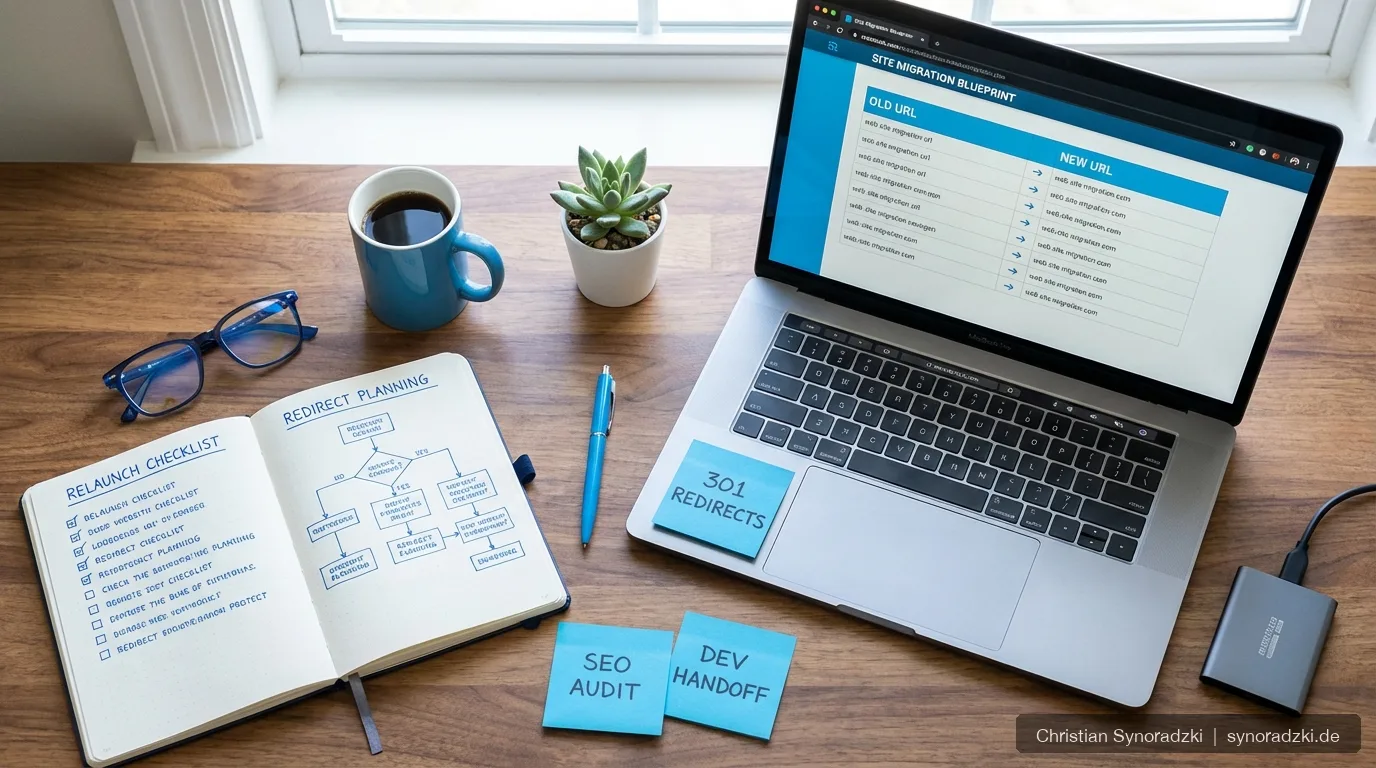
URL mapping is the backbone of any SEO-safe relaunch. Build a complete redirect table:
| Old URL | New URL | Redirect Type |
|---|---|---|
| /old-page/ | /new-page/ | 301 |
| /category/product/ | /shop/product/ | 301 |
Every old URL needs to be mapped to a new URL. For pages that are being removed, redirect to the closest relevant page.
Conduct a Content Audit
A relaunch is the ideal time for a content audit. Evaluate all existing content:
- Keep: Well-ranking pages with current, relevant content
- Revise: Pages with potential that need a content update
- Merge: Similar pages that are cannibalizing each other
- Remove: Outdated pages with no traffic, rankings, or backlinks
During the Relaunch: Technical Execution
Setting Up 301 Redirects Correctly
301 redirects (permanent redirects) transfer the link equity from old URLs to new ones. Key points:
- 1:1 redirects: Each old URL redirects to its matching new URL — not blanket redirects to the homepage
- No redirect chains: Old URL → New URL, not Old URL → Intermediate Page → New URL
- Complete coverage: Verify that no old URL is left without a redirect
Update Internal Links
Update all internal links to point to the new URLs. Don’t rely exclusively on redirects — direct links are always better. Learn more about the importance of internal linking in the article on on-page SEO.
XML Sitemap and robots.txt
- Create a new XML sitemap with all current URLs
- Submit the sitemap in Google Search Console
- Review robots.txt — make sure no important pages are being blocked
- Remove any noindex tags that were set during development
Check Technical SEO Fundamentals
Use the relaunch as an opportunity to set up technical SEO factors correctly from the ground up:
- HTTPS on all pages
- Mobile optimization
- Core Web Vitals
- Structured data
- Canonical tags
After the Relaunch: Monitoring and Follow-Up
The First Days and Weeks
Right after go-live, the most critical phase begins:
- Monitor Google Search Console: Check daily for crawl errors, 404 pages, and indexing issues
- Watch rankings: Minor fluctuations are normal. Sharp drops signal problems
- Log file analysis: Observe how Googlebot is crawling your new website
- Fix 404 errors: Every missing redirect costs you link equity and user experience
Common Mistakes After a Relaunch
Frequent issues that hurt rankings:
- Forgotten 301 redirects for important pages
- Noindex tags from the staging environment not removed
- Internal links still pointing to old URLs
- Canonical tags pointing to wrong pages
- Images and resources returning 404 errors
- Page speed has worsened due to the new design
Be Patient
After a relaunch, Google needs time to fully crawl and evaluate your new website. Short-term ranking fluctuations are normal. Stabilization typically occurs within four to eight weeks. Dramatic losses that persist beyond two weeks, however, require immediate action.
Conclusion
A website relaunch doesn’t have to be an SEO risk — as long as you plan thoroughly. URL mapping, clean 301 redirects, and consistent monitoring after go-live are the three pillars of a successful relaunch.
If you’re planning a relaunch and need professional SEO support, take a look at my services. The blog has current articles on SEO topics and practical experience.
Need support?
As an SEO freelancer with over 20 years of experience, I help you grow your online visibility sustainably.

Über den Autor
Christian SynoradzkiSEO-Freelancer
Mehr als 20 Jahre Erfahrung im digitalen Marketing. Fairer Stundensatz, keine Vertragsbindung, direkter Ansprechpartner.
All articles in the Blog.