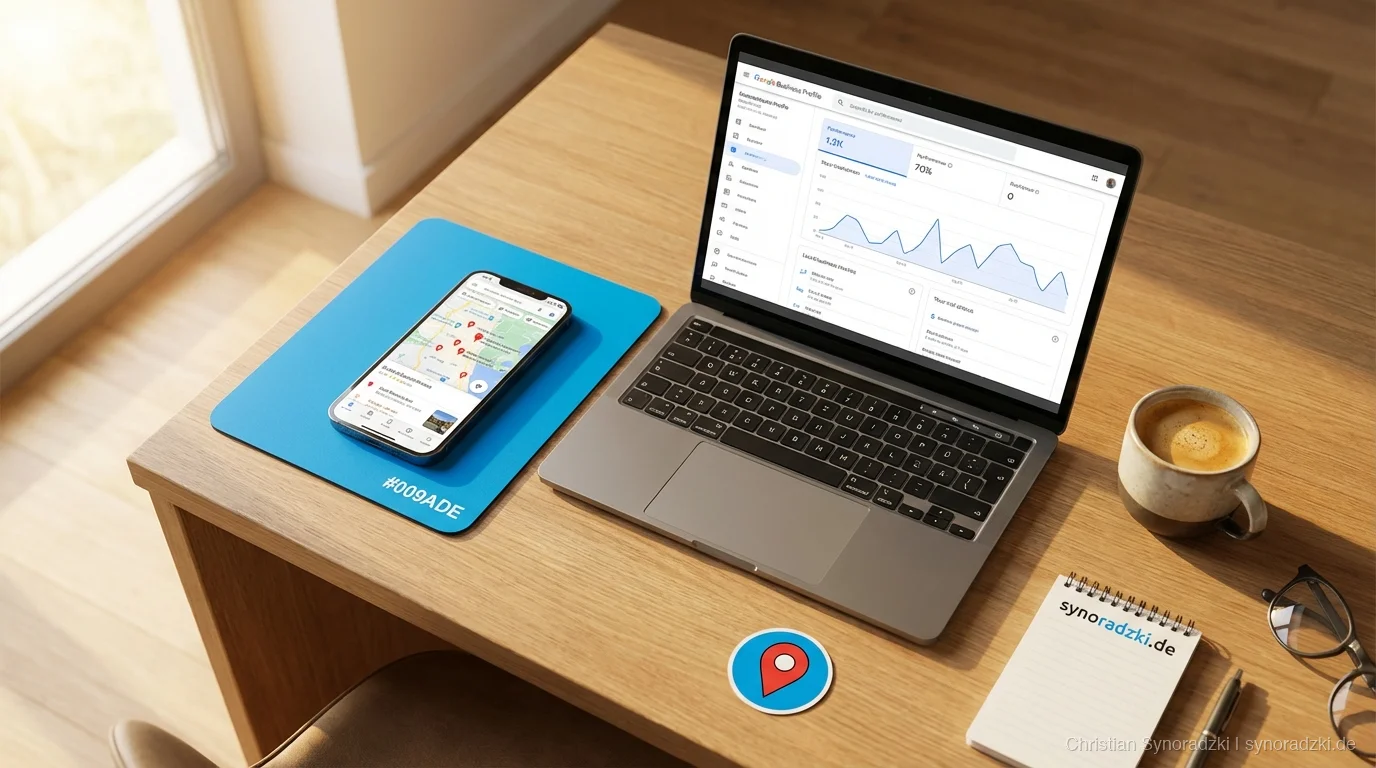
Improving your Google Maps ranking is one of the most effective moves a local business can make: 72% of consumers who perform a local search visit a business within 5 miles on the same day. Showing up in the Local Pack — the three highlighted map listings directly below Google Search — drives inquiries, calls, and customers. This guide shows you exactly how to improve your Google Maps ranking systematically.
What Is the Local Pack and Why Does It Matter?
The Local Pack is the group of three business listings that Google displays for locally relevant searches — directly below paid ads and above the organic results. It includes ratings, opening hours, address, and a direct call button.
“72 percent of consumers who perform a local search visit a store within 5 miles. The Local Pack is where purchase decisions begin.” Amy Bishop, Clix Marketing
What’s More Valuable: the Local Pack or Organic Search?
For local businesses, the Local Pack is often more valuable than ranking #1 in organic results. It appears higher on the page, includes direct contact options, and is especially prominent on mobile. The optimal outcome is a strong Local Pack presence combined with solid organic rankings.
The Three Ranking Factors for Google Maps
Google itself communicates three core factors that determine Maps rankings:
1. Relevance
How well does your business profile match what the user is searching for? Relevance comes from:
- A complete and up-to-date Google Business Profile
- Precise category selection
- Alignment between the search term and your listed services
- Keywords in your business description
2. Distance
Google favors businesses that are geographically close to the searcher. This factor is largely outside your control — other than providing your correct address and service area. Service area settings in your profile help Google understand which regions you serve, even if you don’t have a storefront.
3. Prominence
How well-known and trusted is your business? Prominence is measured through reviews, backlinks, mentions in other directories, social signals, and overall online presence. This is the most actionable of the three factors.
Optimizing Your Google Business Profile
Your Google Business Profile is the centerpiece of any Google Maps strategy. Cut corners here and you pay for it; invest here and you win.
Completeness Is Non-Negotiable
An incomplete profile ranks lower. Fill out every available field:
- Name: Exactly as your business is called — don’t add keywords (Google penalizes this)
- Address: Complete and identical across all other online sources
- Phone number: Direct line, no service numbers
- Website: Link directly to your homepage or the most relevant landing page
- Hours: Keep holiday and special hours up to date
- Category: Primary category as specific as possible, up to 9 additional categories
- Attributes: Accessibility, parking, card payments — enable everything that applies
- Description: 750 characters that include your most important keywords and service area
Use Photos and Videos Actively
Businesses with photos receive 42% more direction requests and 35% more website clicks, according to Google. Upload new images regularly:
- Exterior views (so customers can find you)
- Interiors, team shots, products, completed projects
- Videos (short clips up to 30 seconds work well)
- At least 10 photos for a solid first impression
Google Posts: The Overlooked Feature
Google Posts are short updates published directly in your business profile — visible to anyone who views it. Regular posts signal to Google that your profile is actively maintained:
- Current offers or seasonal promotions
- New services or products
- Events
- Company news
One post per week is a solid rhythm.
NAP Consistency: The Underestimated Foundation
NAP stands for Name, Address, Phone — and consistency means these three pieces of information must be identical everywhere. On your website, in your Google Business Profile, on Yelp, in industry directories, on social media profiles.
Even small discrepancies can confuse Google: “LLC” vs. “Limited Liability Company,” “St.” vs. “Street,” different phone number formats. Run a NAP audit — check all sources and correct any inconsistencies.
A thorough SEO optimization always includes cleaning up NAP data, because it’s the foundation of local rankings.
Building Reviews Systematically
Reviews are the most powerful lever for prominence in Maps rankings. More reviews, a higher average rating, and a steady stream of new reviews — all of these improve your ranking measurably.
How to Get More Reviews
- Ask directly: After every successful project, purchase, or visit, ask for a review
- Create a direct link: In your Google Business Profile under “Get reviews,” you’ll find a short link that takes customers straight to the review form
- QR code: On invoices, business cards, stickers, or receipts
- Email follow-up: Automated follow-up email after a purchase or service
- Reach out to loyal customers personally: Long-term customers often haven’t left a review — ask them directly
How to Respond to Reviews
Respond to every review — positive and negative. This signals engagement to Google and shows customers that you take feedback seriously. For positive reviews, a brief thank-you and the occasional natural keyword works well. For negative reviews, stay factual, show willingness to resolve the issue, and invite direct contact.
Never: buy reviews, ask employees to leave reviews, or pressure customers into positive ratings. Google detects unnatural patterns and can suspend your profile.
Building Local Backlinks
For organic rankings and indirectly for Maps rankings as well, local backlinks matter. These are links from websites that are geographically or topically relevant to you:
- Local newspapers and online media (press releases, guest posts)
- Chambers of commerce and trade associations
- Industry directories and partner sites
- Sponsoring local clubs or events
- Regional bloggers
Every local backlink is a trust signal that Google factors into its assessment of your prominence.
Your Own Website as a Maps Ranking Factor
Your website is closely tied to your Google Business Profile. An optimized website also improves your Maps ranking:
- Local keywords on your website: City name and region must appear in the text, headings, and metadata
- LocalBusiness Schema: Structured data helps Google read your address and hours automatically
- Consistent NAP data: The address on your website must match your Google profile exactly
- Contact page: Full address, phone number, embedded Google Map
- Page speed: A slow website hurts both organic rankings and Maps signals (PageSpeed optimization)
An SEO audit surfaces the technical issues that are holding back your site’s performance.
Common Mistakes with Google Maps Rankings
Mistake 1: Keyword stuffing in the business name. “Smith Plumbing | Plumber NYC Emergency Cheap” violates Google’s guidelines and can get your profile suspended.
Mistake 2: Wrong primary category. A plumber who selects “Home Repair Services” instead of “Plumber” loses relevance for specific searches.
Mistake 3: No regular profile maintenance. A profile that hasn’t been updated in months signals to Google that it’s less active.
Mistake 4: Not responding to reviews. Missing responses signal low engagement — a ranking disadvantage.
Mistake 5: Inconsistent NAP data across directories. Inconsistency weakens Google’s confidence in your profile data.
Google Maps for Different Business Types
Businesses Without a Physical Location
Contractors, consultants, and other mobile service providers can list a service area instead of an address. In this case, location precision is lower — reviews and content become even more important.
Multiple Locations
If you operate multiple locations, create a separate Google Business Profile for each one. Each profile is maintained individually and has its own reviews — but all profiles benefit from a strong parent domain.
New Businesses
For newly established businesses, Google Maps rankings take time. Focus first on a complete profile, your first reviews, and NAP consistency. Prominence grows over time with each new review.
Sharpening the Full Picture with Local SEO
Google Maps and local SEO are two sides of the same coin. Appearing in the Local Pack while also ranking well in organic results means you dominate page one. That comes from:
- A strong Google Business Profile (Maps)
- Local keywords on your website (organic)
- Keyword research for both channels
- Technical SEO as the foundation
- Content optimization for local topics
- Ongoing monitoring with a ranking boost when needed
The services overview gives you a complete picture of what I can do for your local visibility.
Frequently Asked Questions About Google Maps Rankings
How long does it take to appear in the Local Pack? With consistent profile optimization and your first reviews, you’ll often see initial improvements within 4–8 weeks. For highly competitive industries, it can take 3–6 months.
Does Google Ads help with Maps rankings? No — Google Maps rankings and paid ads are separate systems. But Google Ads Local Campaigns can promote your profile additionally.
What if a competitor has keywords in their business name? Report the Google guidelines violation — but also make sure your own categories and content clearly communicate what you offer.
How many reviews do I need for the Local Pack? There’s no magic number. More important than the total count is the combination of volume, recency, and average rating.
Your Next Step Toward More Local Visibility
A better Google Maps ranking doesn’t happen overnight — but with the right actions in the right order, it comes reliably. As an SEO freelancer with over 20 years of experience, I help local businesses get visible in the Local Pack and stay there.
If you’d like to know where your business stands right now and what specifically needs to be done, I’m happy to start with an SEO audit. Or we can simply talk first: Contact me now.
Need support?
As an SEO freelancer with over 20 years of experience, I help you grow your online visibility sustainably.

Über den Autor
Christian SynoradzkiSEO-Freelancer
Mehr als 20 Jahre Erfahrung im digitalen Marketing. Fairer Stundensatz, keine Vertragsbindung, direkter Ansprechpartner.
All articles in the Blog.