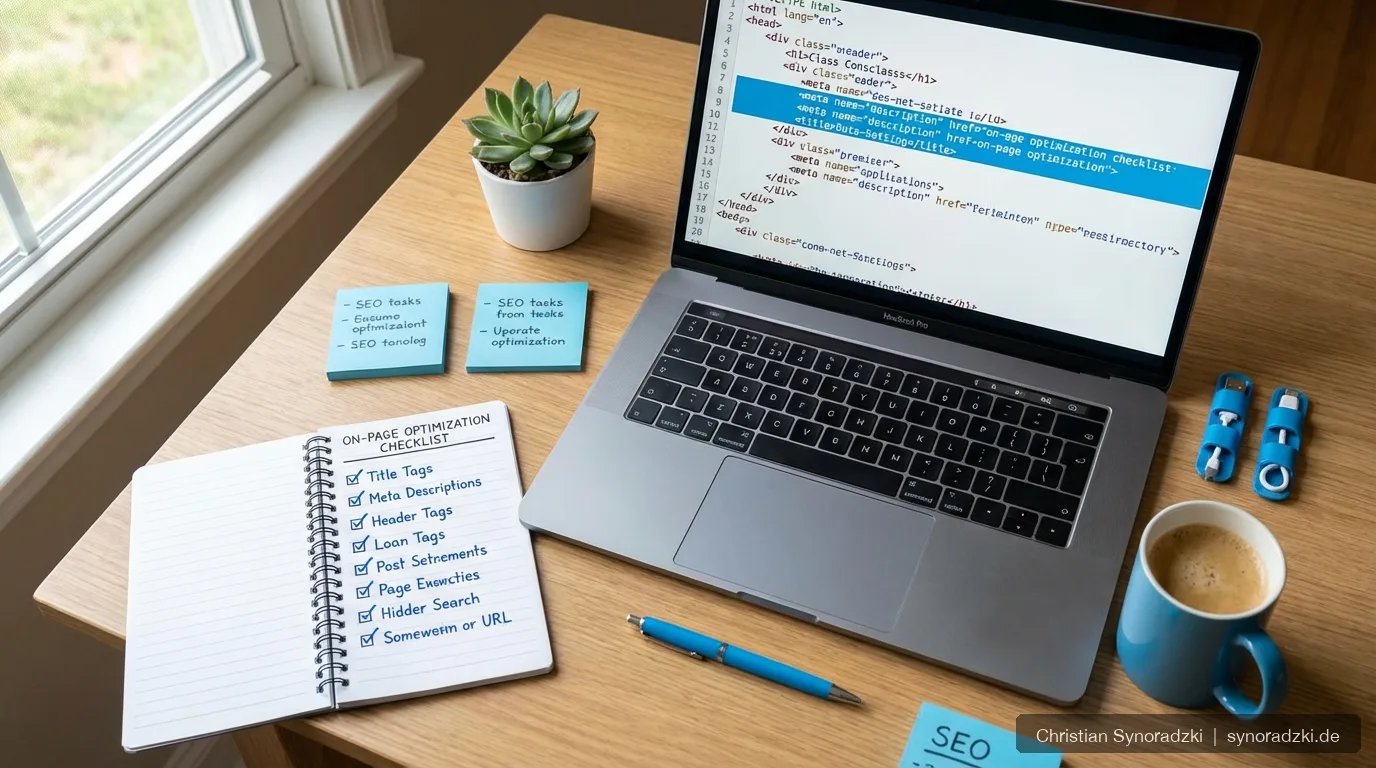
What is OnPage SEO?
OnPage SEO encompasses all optimization measures you make directly on your website. Unlike OffPage SEO, these are factors completely within your control. This makes OnPage optimization the ideal starting point for any SEO strategy.
Search engines like Google evaluate your pages using numerous signals. Many of these you can positively influence through targeted OnPage measures. This guide shows you the most important levers.
Title Tags: First Impressions Matter
The title tag is one of the strongest OnPage signals. It appears as the clickable headline in search results and in your browser tab. A good title tag should:
- Include your main keyword as early as possible
- Be 50 to 60 characters long
- Be unique for each page on your website
- Encourage clicks without being misleading
Avoid generic titles like “Home” or “Welcome.” Every title tag is a chance to signal to both search engines and users what your page is about.
Meta Description: Your Ad in Search Results
The meta description appears as the description text below the title tag in search results. Though not a direct ranking factor, it significantly influences click-through rate. A compelling meta description:
- Summarizes page content in 140–160 characters
- Contains relevant keywords (these appear in bold)
- Includes a clear call-to-action
- Is individually written for each page
Heading Structure: Organization for Content
A clean heading structure helps both users and search engines grasp your content. The H1 tag should appear once per page and reflect your core topic. H2 and H3 tags organize content logically and create clarity.
Make sure to maintain hierarchy: an H2 should be followed by H3, not directly by H4. Keywords in headings are helpful but should feel natural.
Content Optimization: Quality Over Quantity
High-quality content is the foundation of successful OnPage SEO. Google increasingly evaluates content using the E-E-A-T principle – Experience, Expertise, Authority, and Trustworthiness.
For optimized content, follow these principles:
- Match search intent: Understand what users actually want. Learn more in the article on understanding search intent.
- Inform comprehensively: Cover your topic thoroughly without unnecessary padding.
- Ensure readability: Short paragraphs, subheadings, lists, and emphasis make content easier to digest.
- Keep information current: Regularly review and update your content.
Internal Linking: Your Website’s Network
Internal links connect your pages and help Google with crawling and indexing. Thoughtful internal linking:
- Distributes link authority (PageRank) to important pages
- Makes navigation easier for users
- Shows Google thematic connections
- Reduces bounce rates
Use descriptive anchor text that describes the linked page’s content. Avoid generic phrases like “click here.”
Image Optimization
Images can significantly slow down your pages if not optimized. For search-engine-friendly image integration:
- Alt text describing the image and containing relevant keywords
- Compress images without visible quality loss
- Use modern formats like WebP
- Choose descriptive filenames (e.g., “onpage-seo-checklist.webp” instead of “IMG_1234.jpg”)
URL Structure: Short, Clear, and Descriptive
A good URL structure benefits both users and search engines. Optimal URLs are:
- Short and descriptive
- Written in lowercase
- Separated with hyphens, not underscores
- Free of unnecessary parameters or session IDs
Example: /services/onpage-seo-optimization/ is better than /page?id=42&cat=3.
Conclusion
OnPage SEO is not a one-time project but an ongoing process. Start with the most impactful measures – title tags, content quality, and internal linking – then work toward the details. If you need professional support with OnPage optimization, explore my SEO services.
More SEO terms are available in the SEO glossary.
Need support?
As an SEO freelancer with over 20 years of experience, I help you grow your online visibility sustainably.

Über den Autor
Christian SynoradzkiSEO-Freelancer
Mehr als 20 Jahre Erfahrung im digitalen Marketing. Fairer Stundensatz, keine Vertragsbindung, direkter Ansprechpartner.
All articles in the Blog.