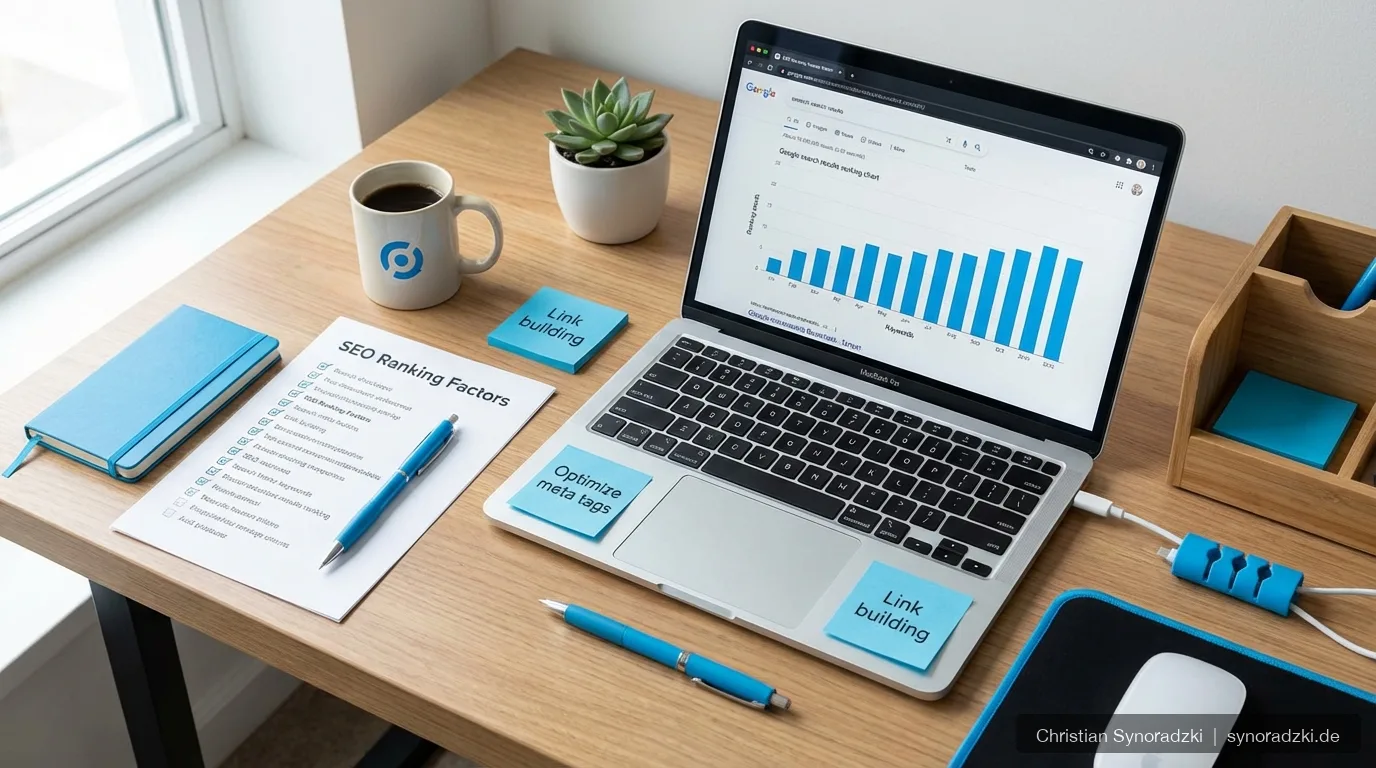
How Does Google Decide on Rankings?
Google uses hundreds of signals to determine search result order. Not all factors carry equal weight, and their importance shifts with every algorithm update. This article gives you an overview of the factors that demonstrably have the greatest impact on rankings in 2025.
Content Quality and Relevance
Content remains the most important ranking factor. Google wants to deliver the best possible answer to a user’s search query. This means:
- Match search intent: Your content must deliver exactly what the searcher is looking for. Learn more in the article on understanding search intent.
- Comprehensive and in-depth: Shallow content gets pushed aside by thorough articles.
- Unique and valuable: Copied or lightly rewritten content has almost no chance.
- Current: Google increasingly penalizes outdated information.
The E-E-A-T framework plays a central role in how Google evaluates content quality. Google checks whether the author has experience and expertise in the topic.
Backlinks
Backlinks remain one of the strongest ranking signals. They function as a vote of trust from other websites. What matters is quality, not quantity.
A single link from a respected, topic-relevant website can be worth more than a hundred links from low-quality sources. Find detailed information in the article on OffPage SEO.
Technical Factors
The technical foundation of your website affects rankings directly and indirectly:
Core Web Vitals
Google measures user experience through Core Web Vitals (LCP, INP, CLS). Pages with poor scores can be ranked lower. Details are in the article on technical SEO.
Mobile-Friendliness
Since the shift to mobile-first indexing, Google evaluates your website exclusively through its mobile version. A non-mobile-optimized website inevitably loses rankings.
HTTPS
Encrypted transmission is a confirmed, though weak, ranking factor. Without HTTPS, browsers also display security warnings that scare away users.
Page Speed
Slow pages cause higher bounce rates and are ranked worse by Google. Optimized load times are especially critical on mobile devices.
OnPage Signals
OnPage optimization includes numerous ranking factors:
- Title tags with relevant keywords
- Meta descriptions that influence click-through rate
- Heading structure that logically organizes content
- Internal linking that conveys relevance and hierarchy
- Image optimization with alt text and compressed files
- Clean URL structure
User Signals
Google watches how users interact with search results. Although Google officially doesn’t confirm direct user signals as ranking factors, numerous studies and leaked Google API documents suggest they matter:
- Click-through rate (CTR): How often is your result clicked?
- Dwell time: How long do visitors stay on your page?
- Pogo-sticking: Do users bounce immediately back to search results?
These signals are a consequence of good content and good user experience—optimize the cause, not the symptom.
Structured Data
Structured data (Schema.org) isn’t a direct ranking factor, but can significantly increase click-through rates through rich results. Indirectly, this improves your rankings.
Local Ranking Factors
Local searches involve additional factors:
- Google Business Profile (completeness and freshness)
- Reviews (quantity, average rating, and recency)
- NAP consistency (name, address, phone number)
- Local backlinks and mentions
Factors That Have Lost Importance
Some once-important factors carry less weight in 2025:
- Keyword density: Google understands semantics. Keyword stuffing hurts more than it helps.
- Exact keyword domains: A domain like “seo-london-cheap.com” provides no real advantage anymore.
- Meta keywords: Ignored by Google for years.
- Text length for its own sake: Longer text doesn’t automatically rank better.
Conclusion
There’s no single ranking factor that determines success or failure. Rather, it’s the combination of high-quality content, solid technical foundations, strong backlinks, and good user experience that leads to sustainable rankings.
Focus on the factors with the biggest impact for your specific situation. More concepts and terminology are available in the SEO glossary. If you need help with implementation, explore my services.
Need support?
As an SEO freelancer with over 20 years of experience, I help you grow your online visibility sustainably.

Über den Autor
Christian SynoradzkiSEO-Freelancer
Mehr als 20 Jahre Erfahrung im digitalen Marketing. Fairer Stundensatz, keine Vertragsbindung, direkter Ansprechpartner.
All articles in the Blog.