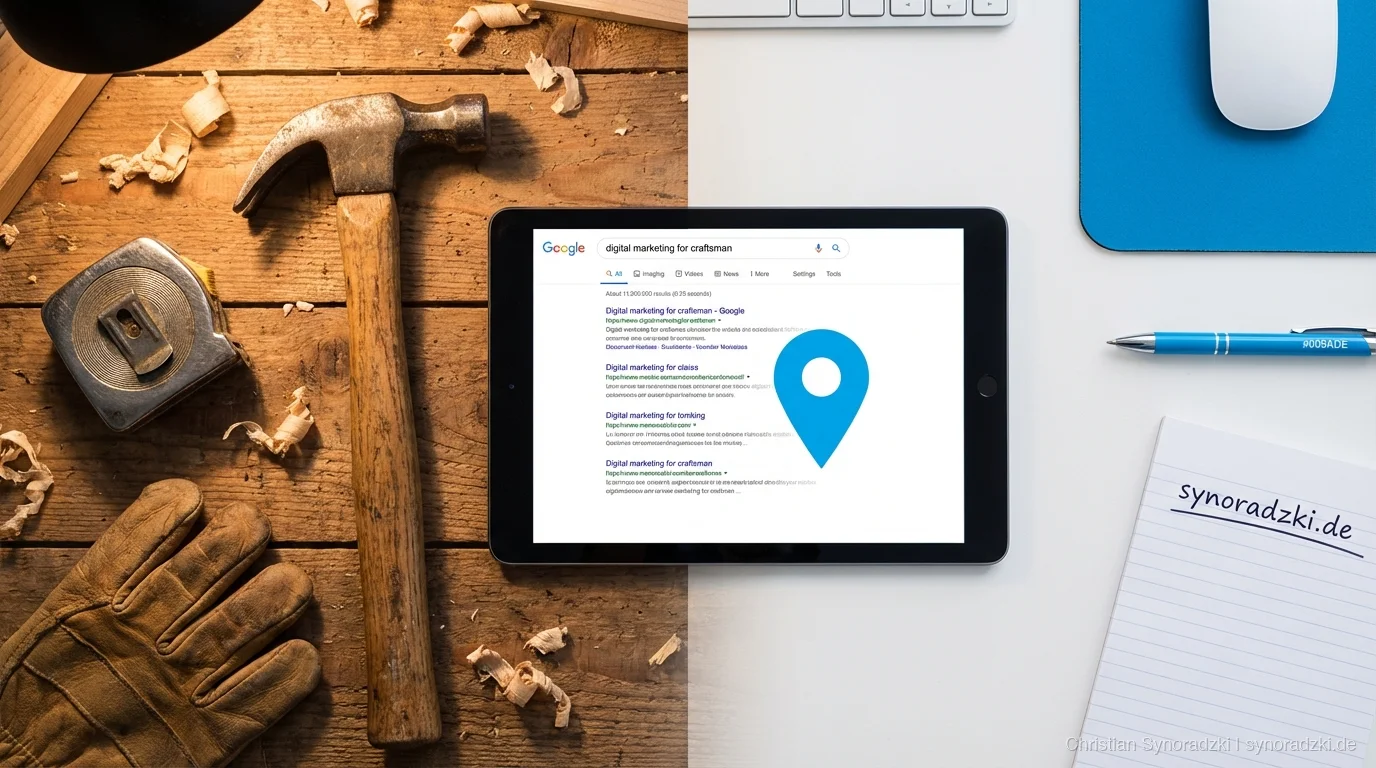
An electrician in Dortmund, a painter in Lünen, a plumbing company in Münster — what these trade businesses have in common: their potential customers search for them on Google every day. Those who rank well in local search results win jobs. Those who don’t simply don’t get called. SEO for tradespeople is no longer a luxury — it’s the foundation of modern customer acquisition.
Why do tradespeople need SEO at all?
The numbers speak clearly: over 80% of consumers now search for local service providers online. Word-of-mouth referrals still work — but increasingly, they begin with a Google search: “electrician near me,” “heating repair Dortmund,” or “tile installer cost.” Whoever shows up in the top three results for those queries gets the call.
The good news for trade businesses: local competition is manageable. Many tradespeople still don’t have a professional online presence — those who invest in local SEO now gain a head start that competitors will struggle to close.
“Content is the reason search began in the first place.” Lee Odden, TopRank Marketing
What does SEO for tradespeople actually mean?
Is local SEO the same as regular SEO?
Local SEO is SEO with a geographic focus: it’s about showing up for searches that include a location or “near me” — specifically in the Local Pack, the three map listings that appear directly under the Google search bar.
For a trade business, this means concretely: optimize your Google Business Profile, align your website with local keywords, and actively collect reviews.
Google Business Profile: the most important lever
The Google Business Profile is the most direct route to local visibility for tradespeople. It appears in the map view and in the Local Pack — even before organic search results are shown.
Here’s how to optimize your profile:
- Completeness: Business name, address, phone number, hours, website — fill in everything
- Category: Choose the primary category as specifically as possible (e.g., “Electrician” instead of “Service Company”)
- Description: Use all 750 characters to describe your services and service area — include natural keywords
- Photos: Before-and-after shots of completed projects demonstrate quality and build trust
- Posts: Regular Google Posts with current offers or projects signal activity
- Services: Add individual trade services as separate entries (e.g., “Bathroom remodel,” “Electrical installation new construction”)
Local keywords: how your customers search
Your website needs to speak your customers’ language. Nobody types “professional electrotechnical installation services” — the reality looks like this:
- “Electrician Dortmund”
- “Roofer near me”
- “Bathroom renovation Lünen”
- “Heating broken what to do”
- “Painting costs per square foot”
Solid keyword research shows you exactly which terms your target audience uses in your area — and how high the search volume is. These keywords then belong in the page titles, headings, and text on your website.
For SEO in the trades: combine trade and city. If you operate in multiple cities, it’s best to create a dedicated subpage for each region.
Reviews: the underestimated ranking factor
Google reviews are doubly valuable for trade businesses: they improve your ranking in the Local Pack and persuade potential customers directly. A business with 50 reviews and a 4.8-star average will almost always be chosen over one with 5 reviews.
Here’s how to collect reviews systematically:
- Actively ask for a review after every successful job
- Send a direct review link to customers (available in the Google Business Profile)
- Place a QR code on invoices, business cards, or vehicle signage
- Respond to every review — including negative ones, professionally and with a solution focus
Your website: the technical foundation
The Google Business Profile brings visibility; the website brings trust and leads. For tradespeople: the website doesn’t need to be complex — but it does need to work.
Checklist for the tradesperson website:
- Mobile-optimized: More than 70% of local searches come from smartphones
- Fast load times: A slow site costs you both rankings and customers (PageSpeed optimization)
- Clear contact options: Phone number prominently in the header, contact form without friction
- Service overview: Each trade service as its own page with a local keyword
- Portfolio: Photos of completed projects with a brief description
- Legal notice and privacy policy: Required — missing both puts you at legal risk
Professional SEO optimization of your website forms the foundation on which all other measures build.
Technical SEO for trade businesses
Even if the topic sounds technical, the basics are manageable. Clean technical SEO for tradespeople covers mainly:
- Correct meta titles and descriptions on all pages
- Structured data (LocalBusiness Schema) so Google recognizes your business as a local company
- Clean URL structure (e.g., /electrician-dortmund/ instead of /page?id=42)
- SSL certificate (https://) — mandatory today
- Sitemap and correct robots.txt
Trade sectors: who benefits most?
SEO works in nearly all trade sectors, but some benefit particularly strongly:
- Plumbing, heating, HVAC: High urgency, customers search immediately
- Electricians: Regular demand, little price comparison in emergencies
- Painters and decorators: Seasonal peaks, many comparison searches
- Roofers: High job value, worthwhile investment in visibility
- Carpenters and cabinet makers: Longer decision cycles — content and reviews are especially important
In my industry overview you’ll find specific information for SEO in the trades and other sectors.
Common SEO mistakes tradespeople make
Mistake 1: No or incomplete Google Business Profile. That’s like a phone book with no listing — customers simply can’t find you.
Mistake 2: Writing your address and phone number differently in different places. “Main St. 5” on your website and “Main Street 5” in your Google Profile — that confuses Google and weakens your NAP consistency.
Mistake 3: Not actively asking for reviews. Satisfied customers rarely leave a review on their own. Ask consistently.
Mistake 4: Websites without local keywords. A page that only says “painting company” but never mentions “painter Dortmund” or “painting work Lünen” will rarely show up in local searches.
Mistake 5: Neglecting the mobile site. If you only check your website on a desktop, you’ll often miss serious problems on mobile — your target audience’s most important device.
How quickly does SEO show results for tradespeople?
The Google Business Profile can show better placements within a few weeks, especially if you collect many reviews and actively maintain the profile. Website rankings typically require 3–6 months before noticeable improvements become visible.
The advantage over Google Ads: once SEO is working, it delivers inquiries continuously — without paying for each click.
Invest in local visibility now
Most trade businesses win new customers through Google today — whether they know it or not. Those who build their online presence professionally gain a competitive advantage that grows the longer it’s in place.
I help trade businesses get found on Google — with fair rates and no long-term contracts. Let’s clarify in a brief conversation what’s possible for your business. Contact me now.
Need support?
As an SEO freelancer with over 20 years of experience, I help you grow your online visibility sustainably.

Über den Autor
Christian SynoradzkiSEO-Freelancer
Mehr als 20 Jahre Erfahrung im digitalen Marketing. Fairer Stundensatz, keine Vertragsbindung, direkter Ansprechpartner.
All articles in the Blog.