What Is Technical SEO?
Technical SEO is the foundation of every successful SEO strategy. It ensures that search engines can efficiently crawl, understand, and index your website. Even the best content stays invisible when technical barriers block search engine bots from accessing it.
While on-page SEO focuses on content and its optimization, technical SEO deals with the infrastructure of your website.
Crawling: How Search Engines Discover Your Website
Before Google can show a page in search results, Googlebot first has to find and scan it — this process is called crawling. The bot follows links from page to page and records the content it finds.
Making the Most of Your Crawl Budget
Google assigns every website a limited crawl budget. This means Googlebot visits only a certain number of pages per visit. For large websites, using this budget efficiently is critical.
Here’s how to optimize your crawl budget:
- Remove duplicate content or mark it with canonical tags
- Block irrelevant pages (e.g., filter pages, internal search results) in robots.txt
- Keep your site hierarchy shallow with short click paths
- Use an XML sitemap to highlight your most important pages
- Fix redirect chains and avoid unnecessary redirects
Indexing: From Crawl to Search Result
After crawling, Google decides whether to include a page in its index. Not every crawled page gets indexed. Common reasons for missing indexing include:
- Noindex tag: The page is intentionally or accidentally excluded from indexing
- Duplicate content: Google identifies the page as a duplicate and only indexes the original
- Thin content: The page offers too little value
- Crawl errors: Googlebot can’t reach the page (e.g., due to 5xx errors)
Check the indexing status of your pages regularly in Google Search Console. You’ll also find hints about potential issues there.
Page Speed and Core Web Vitals
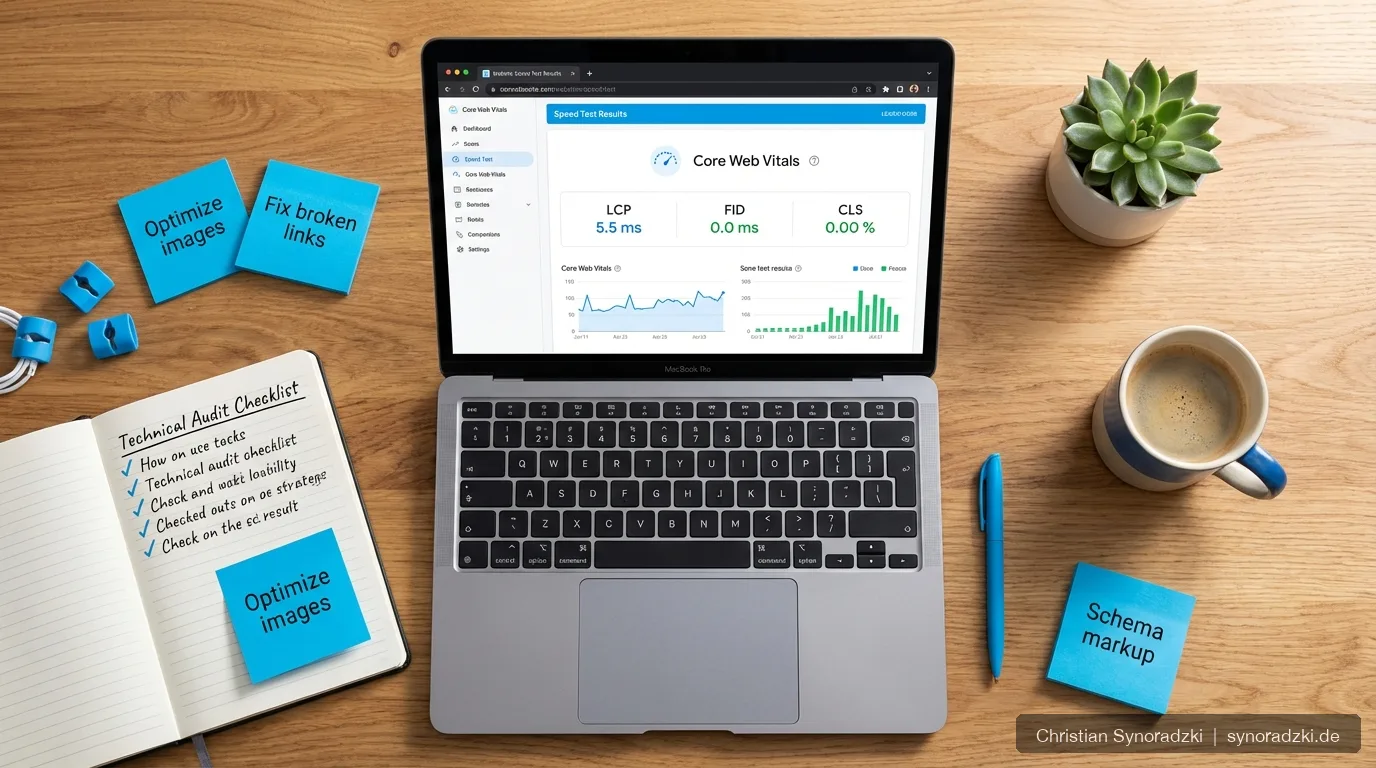
Load speed is a confirmed Google ranking factor. Since the introduction of Core Web Vitals, Google evaluates user experience using three metrics:
- Largest Contentful Paint (LCP): Measures the load time of the largest visible element. Target: under 2.5 seconds.
- Interaction to Next Paint (INP): Evaluates the page’s responsiveness to user interactions. Target: under 200 milliseconds.
- Cumulative Layout Shift (CLS): Captures unexpected layout shifts. Target: under 0.1.
Steps to Improve Speed
- Compress images and use modern formats like WebP
- Minify CSS and JavaScript, and defer non-critical resources
- Reduce server response times through caching and reliable hosting
- Self-host fonts instead of loading them from external services
Mobile-First Indexing
Since 2021, Google indexes websites exclusively via their mobile version (mobile-first indexing). This means your mobile website is the basis for rankings — including desktop search.
Make sure that:
- Your website uses responsive design
- All content is available on the mobile version
- Touch elements are large enough and properly spaced
- Text is readable without zooming
HTTPS and Security
HTTPS has been a ranking signal for years. An encrypted connection protects your users’ data and builds trust. Pay attention to:
- A valid SSL certificate
- Correct redirects from HTTP to HTTPS
- No mixed-content warnings (HTTP resources on HTTPS pages)
Structured Data
With structured data (Schema.org), you help search engines better understand your content. It enables rich snippets in search results — such as star ratings, FAQ sections, or event information.
Auditing Technical SEO
Regular technical audits identify problems before they negatively affect your rankings. A technical check is especially important before and after a website relaunch.
Useful tools for technical SEO audits include Google Search Console, Google PageSpeed Insights, and Screaming Frog.
Need help with technical optimization? Learn more about my SEO services.
Need support?
As an SEO freelancer with over 20 years of experience, I help you grow your online visibility sustainably.

Über den Autor
Christian SynoradzkiSEO-Freelancer
Mehr als 20 Jahre Erfahrung im digitalen Marketing. Fairer Stundensatz, keine Vertragsbindung, direkter Ansprechpartner.
All articles in the Blog.